


Australian Potash Companies
Take me to Potash News with an Australian Focus
Phosphate is not Potash! (And not all potash is equal)
Please note that this is a rapidly changing field and that the data contained will inevitably be out of date some of the time; meaning that you should not rely on it to make investment decisions and consequently you must do your own research.
Australia is a substantial Potash consumer but currently has no production.
Australia has 6 ASX listed companies that have JORC compliant Potash resources of over 10Mt.
N.B. BHP has around 1B t of Potash resources.
There are basically two main types of brine lake Potash used in agriculture. KCL Muriate of Potash (MOP) which is mainly used for broadacre crops (wheat, corn etc) and K2So4 Sulphate of Potash (SOP) which is used for green leafy vegetables including broccoli, lettuce etc.
Not all Potash are equal:

The price disparity shown above relates to end use,follow this linkto see which crops tolerate MOP.
Read more at http://www.australianminesatlas.gov.au/aimr/commodity/potash.html
2014 USGS 2014 Potash Update (pdf)
Potash is used primarily as an agricultural fertilizer
(plant nutrient) because it is a source of soluble potassium,
one of the three primary plant nutrients; the others are fixed
nitrogen and soluble phosphorus. Potash and phosphorus are mined
products, and fixed nitrogen is produced from the atmosphere by
using industrial processes. Modern agricultural practice uses
these primary nutrients in large amounts plus additional nutrients,
such as boron, calcium, chlorine, copper, iron, magnesium,
manganese, molybdenum, sulfur, and zinc, to assure plant health
and proper maturation. Apparent consumption of all forms of potash increased by 12% to 5.50 Mt from 4.90 Mt in Crop Year 2012, owing to higher potash fertilizer use. More
ASX Companies with JORC Potash Resources >10Mt
http://www.australian-shares.com/mining/ELM
http://www.australian-shares.com/mining/ORE
Muriate of potash (MOP), sulphate of potash (SOP)
http://www.australian-shares.com/mining/RWD
Potassium Sulphate (SOP)
http://www.australian-shares.com/mining/RIO
http://www.australian-shares.com/mining/HFR
Muriate of potash (MOP)
http://www.australian-shares.com/mining/DNK
Range of potash types including sulphate of potash (SOP or potassium sulphate), muriate of potash (MOP or potassium chloride) and sulphate of potash magnesia (SOPM or potassium magnesium sulphate).
http://www.australian-shares.com/mining/AIV
Potassium sulphate (SOP) and other fertiliser products such as ammonium sulphate (SOA)
Potash News _ Australian Focus
ASX listed companies with some potash interests
Read more about Australian potash industry developments
Potassium oxide in fertilizers
The chemical formula K2O is used in the N-P-K (nitrogen-phosphorus-potassium) numbers on the labels of fertilizers. Although K2O is the correct formula for potassium oxide, potassium oxide is not used as a fertilizer in these products. Normally, potassium chloride, potassium sulfate, or potassium carbonate is used as a fertilizer source for potassium. The percentage of K2O given on the label only represents the amount of potassium in the fertilizer if it was in the form of potassium oxide. Potassium oxide is about 83% potassium by weight, but potassium chloride, for instance, is only 52% potassium by weight. Potassium chloride provides less potassium than an equal amount of potassium oxide. Thus, if a fertilizer is 30% potassium chloride by weight, its standard potassium rating, based on potassium oxide, would be only 19%.
Potash refers to potassium compounds and potassium-bearing materials, the most common being potassium chloride (KCl). The term "potash" comes from the old-Dutch word potaschen. The old method of making potassium carbonate (K2CO3) was by leaching wood ashes and evaporating the solution in large iron pots, leaving a white residue called "pot ash". Later, "potash" became the term widely applied to naturally occurring potassium salts and the commercial product derived from them. http://en.wikipedia.org/wiki/Potash
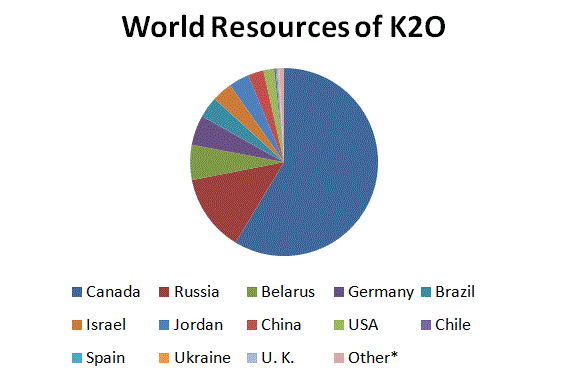
Circa 2004
Please note that this is a rapidly changing field and that the data contained will inevitably be out of date some of the time; meaning that you should not rely on it to make investment decisions and consequently you must do your own research.
Take me to Potash News with an Australian Focus
The data on Australian Phosphate.com is intended as a guide only and is provided purely as an indication of what information can be found through official announcements. Data on this website should not be used to make an investment or trading decision. All information should be carefully cross-checked against official sources for accuracy. The publisher (Intaanetto Social Media) will not be held liable for any loss arising from the use of this website. Persons associated with Intaanetto the publishers of Australian Phosphate hold one or more of the companies listed above.

Ads by Google
Related Links
e-stockbroker.com.au
australian-gold.com
alternative-energy.com.au
ucg-gtl.com
hotrockenergy.com
australianuranium.com.au
australian-gas.com
australian-lithium.com
australianrareearths.com
Social Media
http://twitter.com/AusAltEnergy
Related News
Nutrien (NTR) Q1 2026 Earnings Transcript - The Globe and Mail
Fertilizer supply crisis deepens - The Western Producer
Fertilizer spike adds up to $35/acre for US corn as Iran crisis deepens - AgFunderNews